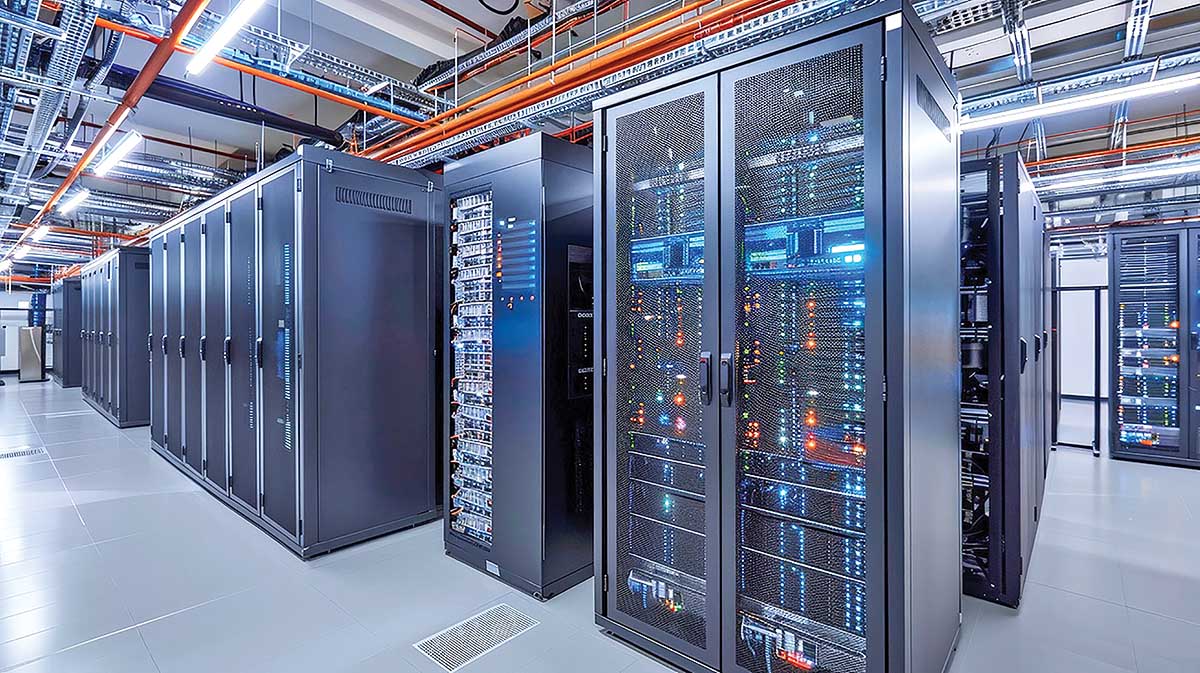

The growth of artificial intelligence (AI), cloud computing, and the digital economy is driving demand for data center development in Vietnam. The country currently has approximately 41 commercial data centers with a total designed capacity of 221 MW. According to research by Arizton Advisory & Intelligence, Vietnam’s data center market was valued at approximately USD 1.04 billion in 2025 and is projected to reach USD 3.19 billion by 2031. These figures reflect the market’s significant growth potential while highlighting the urgent need to develop corresponding energy infrastructure.
Electricity is a critical factor in data center operations. Unlike many types of commercial real estate, data centers must maintain uninterrupted operations across servers, networking equipment, cooling systems, and auxiliary facilities. For AI-focused projects, high computing power density further increases requirements for electricity supply, heat dissipation, and overall system reliability. Therefore, access to power affects not only operating costs but also the feasibility of investment locations, project scale, and long-term expansion potential.
Challenges Posed by Vietnam’s Current Electricity Pricing Mechanism
As Vietnam increasingly attracts data center projects, particularly large-scale facilities serving artificial intelligence (AI) and cloud computing, access to a reliable electricity supply at reasonable costs has become a key determinant of project feasibility.
Unlike many conventional real estate and infrastructure developments, data centers require continuous operations and substantial electricity to power servers, cooling systems, and supporting equipment. Consequently, electricity costs represent a significant component of operating expenditure and directly affect financial models, competitiveness, and long-term investment returns. For large-scale projects, uncertainty surrounding electricity pricing mechanisms can affect total cost of ownership calculations, pricing for infrastructure colocation services, customer contract negotiations, and payback period assessments. Accordingly, in addition to the actual electricity tariff, the transparency, consistency, and predictability of electricity pricing policies are important considerations in investment decision-making.
One issue currently attracting attention in Vietnam is the determination of electricity tariffs applicable to data centers, particularly the classification of electricity consumption for production versus business and service activities. A prominent recent controversy concerns whether production or business electricity tariffs should apply to certain data centers operated by Viettel and CMC. The matter has been reported to the Ministry of Industry and Trade, Vietnam Electricity (EVN), and the Ho Chi Minh City People’s Committee for resolution.
Expert Perspectives
In general, experts believe that an electricity pricing mechanism for data centers should be developed with consideration of their electricity consumption characteristics, market principles, and national energy security requirements. Their views on the applicable pricing framework are summarized below.
First, consider a two-component electricity pricing mechanism comprising capacity charges and energy charges.
Nguyen Huy Hoach, an energy expert at the Scientific Council of the Vietnam Energy Review, argues that regulators should establish consistent classification criteria and clarify how existing regulations are applied. This would help prevent data centers with similar operational characteristics from being subject to different electricity pricing methods.
Electricity pricing for data centers should not be limited to classifying consumption as either production or business activity. Instead, it should be considered within the broader framework of energy policy and digital infrastructure development. According to Hoach, electricity tariffs should reflect the purpose of consumption, load characteristics, and the costs incurred by the power system to supply electricity. Data centers should not automatically be treated as eligible for preferential tariffs, but any higher tariff must also have a clear and justified basis. He emphasizes that predictable electricity pricing policies are important for maintaining a stable investment environment. In the longer term, Vietnam could consider a two-component electricity pricing mechanism comprising capacity charges and energy charges to better reflect each project’s load scale and consumption characteristics.
Regarding tariff determination, Mr. Hoach also stresses the need to clearly distinguish the responsibilities of EVN and electricity distribution entities in implementing regulated retail electricity tariffs. Where differing interpretations arise, the relevant policies should be clarified and harmonized by the competent state authorities rather than left to individual electricity providers to interpret independently. Mr. Hoach proposes studying an electricity pricing mechanism tailored to data centers, potentially incorporating both capacity and energy charges. Such a mechanism should account for load scale, operating hours, reliability requirements, and demand-response capabilities. At the same time, data center development must be aligned with power generation and grid planning to ensure that electricity is available at the right location and time, with an adequate level of reliability. Accordingly, the key solutions include clarifying regulations, establishing a consistent electricity pricing framework nationwide, and proactively planning generation and grid infrastructure to meet growing demand. Investors should also select locations, project scales, and development schedules that align with available power capacity, while considering solutions such as on-site power generation, energy storage, and demand response.
Second, determine electricity tariffs based on the substance of the business activity while balancing them against investment incentives.
Associate Professor Nguyen Thuong Lang of the Institute for Trade and International Economics approaches the issue from an economic perspective. He considers data center development an important priority in Vietnam’s national digital transformation. However, policies must remain transparent and strike a balance between encouraging investment and safeguarding energy security. Whether production or business electricity tariffs apply should depend on the substance of the activity and the applicable legal provisions. Although data centers may consume substantial amounts of electricity to operate their server infrastructure, their core services involve leasing infrastructure and servers and providing data storage and processing services for a fee. Therefore, the application of production electricity tariffs requires comprehensive assessment and cannot be justified solely on the grounds that electricity is used to operate technical systems. Mr. Lang also emphasizes that energy planning must be coordinated with data center development planning. Data centers are energy-intensive facilities, while electricity supply continues to face considerable pressure. Consequently, policy should not focus exclusively on reducing electricity prices while overlooking the national power system’s capacity to meet demand.
To encourage data center investment, Mr. Lang argues that the government should introduce specific incentives relating to land and electricity tariffs. These incentives could be designed to allow businesses to choose the form of support most appropriate to their circumstances, rather than automatically combining the maximum available benefits. In addition, data centers should be encouraged to develop on-site power generation and diversify their energy sources, including solar power, wind power, and waste-to-energy, while exploring new models when technically and legally feasible. Given the constraints on electricity supply, investment attraction should be accompanied by reasonable pricing policies and viable energy supply solutions. This would help balance the interests of the government and businesses while ensuring that development proceeds in line with actual conditions.
Third, consider an electricity pricing mechanism based on the characteristics of electricity supply and consumption.
Economic expert Dinh Tuan Minh argues that classifying electricity tariffs primarily according to whether electricity is used for production (for a company’s own operations) or services (for provision to other entities) may not fully reflect the diversity of modern business models. He notes that a large shopping mall can consume as much electricity as, or sometimes even more than, a manufacturing business. From this perspective, electricity tariffs could be designed based on multiple factors, including consumption volume, operating hours, and voltage level. Such an approach could better reflect electricity supply costs and encourage more efficient energy use.
Overall, these expert perspectives indicate that the electricity challenges facing data centers cannot be resolved simply by lowering tariffs. An effective framework must combine transparent pricing policies, reliable electricity supply, energy infrastructure planning, and measures to improve energy efficiency.
For investors, assessing data center projects in Vietnam therefore requires simultaneous consideration of two dimensions: electricity costs and the reliability of power supply. Proactively evaluating site suitability, power demand, supply arrangements, and expansion capacity during the pre-investment stage can help mitigate risks and improve project implementation outcomes.
With experience in data center investment advisory and project development in Vietnam, DCOMPASS supports investors in site assessment, technical infrastructure due diligence, legal review, and the development of appropriate implementation strategies. These services help address electricity infrastructure constraints, optimize costs, and enhance project feasibility from the earliest stages of investment preparation.
Reference:
Thanh Nien Newspaper (2026), “Solving the Electricity Challenge for Data Centers”, https://thanhnien.vn/giai-bai-toan-dien-cho-cac-trung-tam-du-lieu-18526101722255648.htm